
Why is AI lease abstraction so hard for US retail leases?
Quick answer
AI can read a US retail lease, but reading is the easy part. Percentage rent, CAM and taxes depend on formulas and on data the lease doesn't contain, so a reliable abstract also needs fixed calculation rules and a person to confirm the inputs.
AI can read a US retail lease and pull out the parties, dates and base rent quickly. The hard part comes next. Much of what a retail lease costs isn't written in it as a number. It is a formula, and the formula needs figures that arrive years later: store sales, the landlord's actual costs, last year's controllable expenses, whether the anchor is still open.
So a good retail abstract needs three things working together:
- A language model to read the clause and turn it into structured terms with a citation.
- Fixed rules to do the math and check the terms against each other, the same way every time.
- A person to confirm the judgment calls, such as which sales count.
A model alone can give you a tidy summary of these clauses. It can't give you a number you should bill or pay.
Percentage rent changes every time base rent changes
Percentage rent is paid on top of base rent once sales pass a breakpoint. A natural breakpoint is base rent divided by the percentage rate. It sounds like a single value to extract, but it isn't one.
Here is a sample lease written for this article: 6% percentage rent over a natural breakpoint, $150,000 starting base rent, and 3% annual increases.
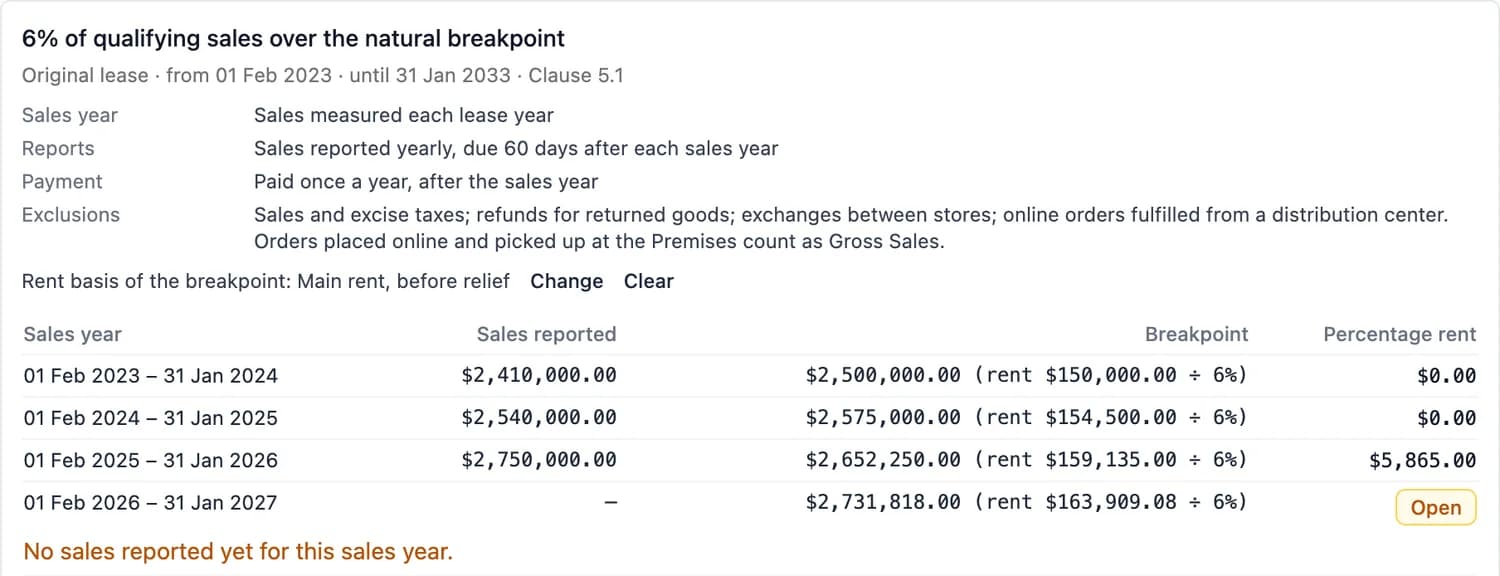
- Year 1: rent of $150,000 gives a $2,500,000 breakpoint.
- Year 2: rent of $154,500 gives a $2,575,000 breakpoint.
- Year 3: rent of $159,135 gives a $2,652,250 breakpoint.
Say year 3 sales are $2,750,000. The tenant owes 6% of the $97,750 above the breakpoint, which is $5,865.
If an abstract records "breakpoint: $2,500,000" and nobody updates it, the bill is $15,000. That is $9,135 too much, and nothing about the abstract looks wrong. The right field is the rule that produces the breakpoint each year, not one figure.
The formula isn't always the same
The overage formula above is common, but leases don't all follow it. Two leases filed with the SEC show how much the wording varies:
- A 1996 theatre lease charges the rate on all gross receipts, minus minimum rent paid. Its example gives $24,000 on $2,400,000 of receipts. A later sentence in the same section takes the rate on the excess over the breakpoint, then says "less any Minimum Rent previously paid." Read literally, that sentence would subtract the rent a second time and leave nothing owed.
- A Sears and Lands' End amendment charges the greater of scheduled rent or a percentage of gross sales. The tenant pays scheduled rent monthly, then reconciles within 30 days after the fiscal year ends.
A model asked to summarize the first clause may report either version without mentioning that they conflict. This is why a rule shouldn't simply assume one formula. It should be selected from what the clause says, and a conflict should go to a person.
Gross sales is a definition, not a number
The rate only matters once you know which sales count, and each lease draws that line differently:
- The theatre lease counts phone and mail orders attributable to the premises, even if filled elsewhere. It excludes employee sales only up to 2% of gross receipts.
- The Lands' End amendment excludes gift cards until they are redeemed.
CAM depends on a denominator and a cap
For CAM, the tenant's share looks like simple division: its area over the center's area. The dispute is over the bottom number. Take a 5,000 sq ft tenant and a $900,000 cost pool:
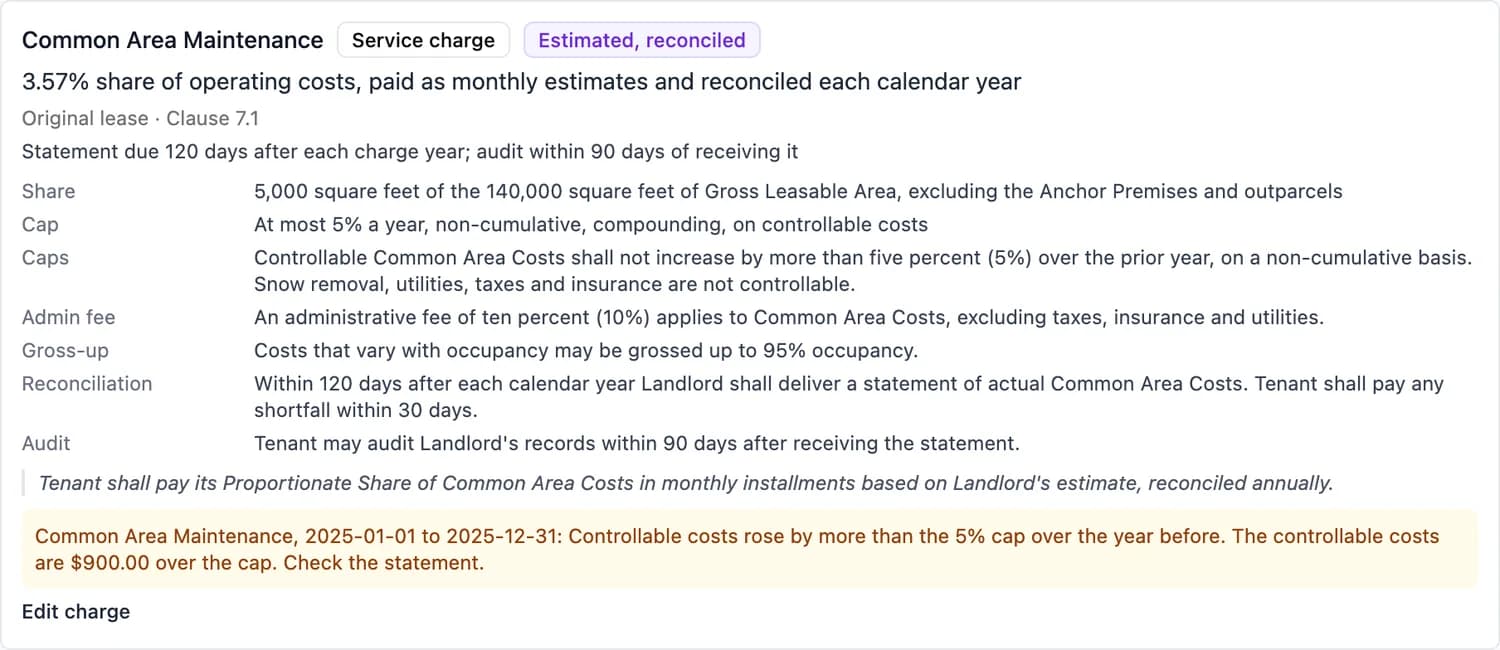
- 140,000 sq ft of leasable area, anchors excluded: a 3.57% share, about $32,143.
- 210,000 sq ft, anchors included: a 2.38% share, about $21,429.
- 120,000 sq ft, counting only space that is actually leased: a 4.17% share, $37,500.
These are all plausible drafting choices. If the abstract says only "pro rata share: 3.57%," you can't test that percentage later, when an anchor leaves or space is remeasured. You need the definition behind it too.
One word in the cap changes the bill
A 2025 shopping center law conference paper has a clear example of a 3% cap, with CAM of $5.00, $5.00 and $5.25 per sq ft over three years:
- Cumulative and compounding: the year 3 cap is about $5.30, so the landlord can pass through the full $5.25.
- Non-cumulative: the year 3 cap is $5.15, so the extra $0.10 is lost.
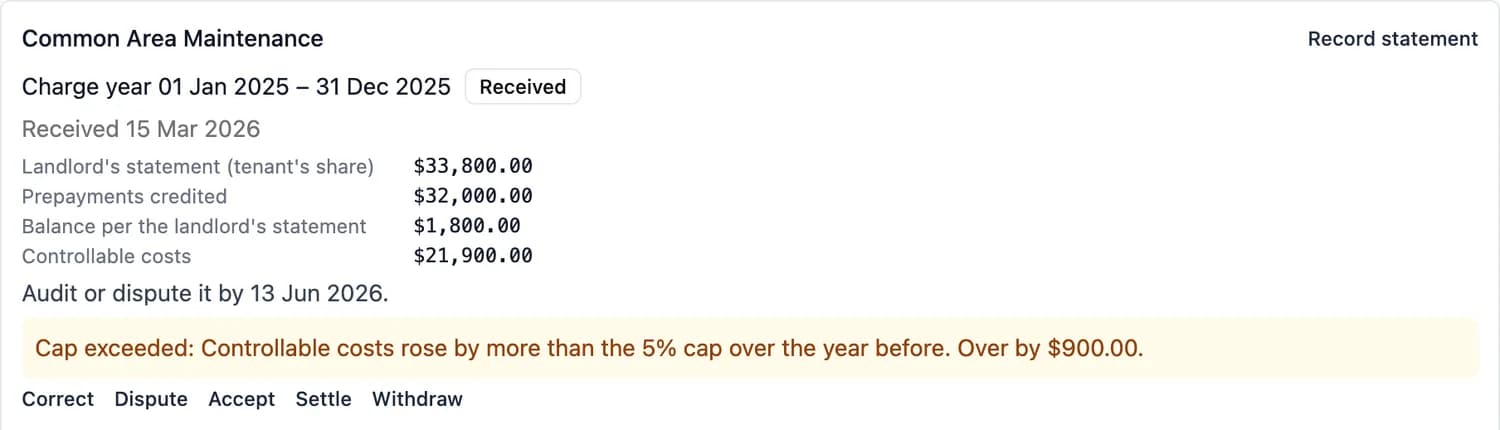
On 5,000 sq ft, that is $500 for that year, and the gap carries into later years. To check a cap, a system needs the cap's type, its base year and last year's actual controllable costs. Those costs aren't in the lease, and neither is the answer to whether a new cost is controllable.
Fees need the same care. The theatre lease adds overhead of 10% of Common Area Expenses. A 2018 conference paper describes management fees of 3% to 5% applied to all rent collected, so the base of the percentage matters as much as the rate. Gross-up clauses add more inputs: which cost lines vary with occupancy, the actual occupancy and the target.
Taxes aren't just a smaller CAM bill
Real estate taxes are usually billed alongside CAM, but they follow their own rules:
- What counts as tax: landlords seek broad definitions, while tenants try to exclude items such as income and transfer taxes and penalties for late payment.
- Which share applies: the tax share can differ from the CAM share. The theatre lease also charges the tenant 100% of tax increases caused by its own work.
- Events outside the lease: in California, a sale is generally a change in ownership, which can reset the assessed value. Some tenants negotiate protection against that, so the same tax bill can be passed through in full under one lease and only in part under another.
The tax bill, the sale and the appeal all happen outside the lease. The abstract has to hold the clause in a form that can be applied when they do.
Why a language model alone falls short
- The inputs aren't in the document. No model can calculate 2025 percentage rent from a 2019 lease without 2025 sales.
- Wrong numbers look like right ones. A $15,000 answer reads as confidently as a $5,865 answer.
- Answers should be repeatable. A bill needs the same result from the same inputs, and steps an auditor can follow.
- Numbers are a weak spot. A 2026 workshop paper tested clause extraction on 510 commercial contracts. Numeric and obligation claims failed far more often than date claims, a gap of about 38 to 40 percentage points. These weren't leases specifically, but the numbers in a retail lease are the ones that matter most.
What fixed rules should do, and where they should stop
Hard-coded rules are the right tool for retail leases, but they need limits. Good ones:
- Do the arithmetic in code. Breakpoints, caps and proration should never be left to a model.
- Check the terms against each other. For example, a clause that says "natural breakpoint" should match rent divided by rate in every year, after every step.
- Apply only when the clause fits. The same check would wrongly flag a negotiated fixed breakpoint, because it is meant to differ from that result.
- Have a third answer besides right and wrong. Missing sales, a partial year or an unusual tier should produce "can't be worked out yet, and here's why," not a guess.
- Show every step, with each input traced to a clause or a report.
How LeaseWizard handles this
LeaseWizard keeps these jobs apart. The model reads the lease into structured, cited terms. Code does the calculations, and amounts it can't work out stay open with the reason.
For percentage rent, as in the first screenshot, an administrator records qualifying sales and confirms which rent counts toward a natural breakpoint. LeaseWizard then calculates each full sales year.
For CAM, the lease's share definition, cap, fee and gross-up wording sit next to the charge:
When the landlord's statements arrive, they are recorded with their audit deadlines, and controllable costs are compared with a non-cumulative, compounding cap:
How to test any tool on your retail leases
Before you trust a tool with retail leases, use one of your own and ask it to do the following:
- Give the natural breakpoint for year 5 of a lease with stepped rent.
- Show what it says when sales are missing or cover only part of a year.
- Show the definition behind the CAM share, not only the percentage.
- Tell a cumulative cap from a non-cumulative one.
- Point to the clause behind every number.
- Run an amendment that changes the rate or the breakpoint, and show which term applies to which year.
A tool that gives a confident number with missing inputs fails the most important test. For more on review workflows, see why validation matters for lease extraction and how to use AI for lease audits.
This article is general information, not legal advice. What you owe depends on the wording of your lease.