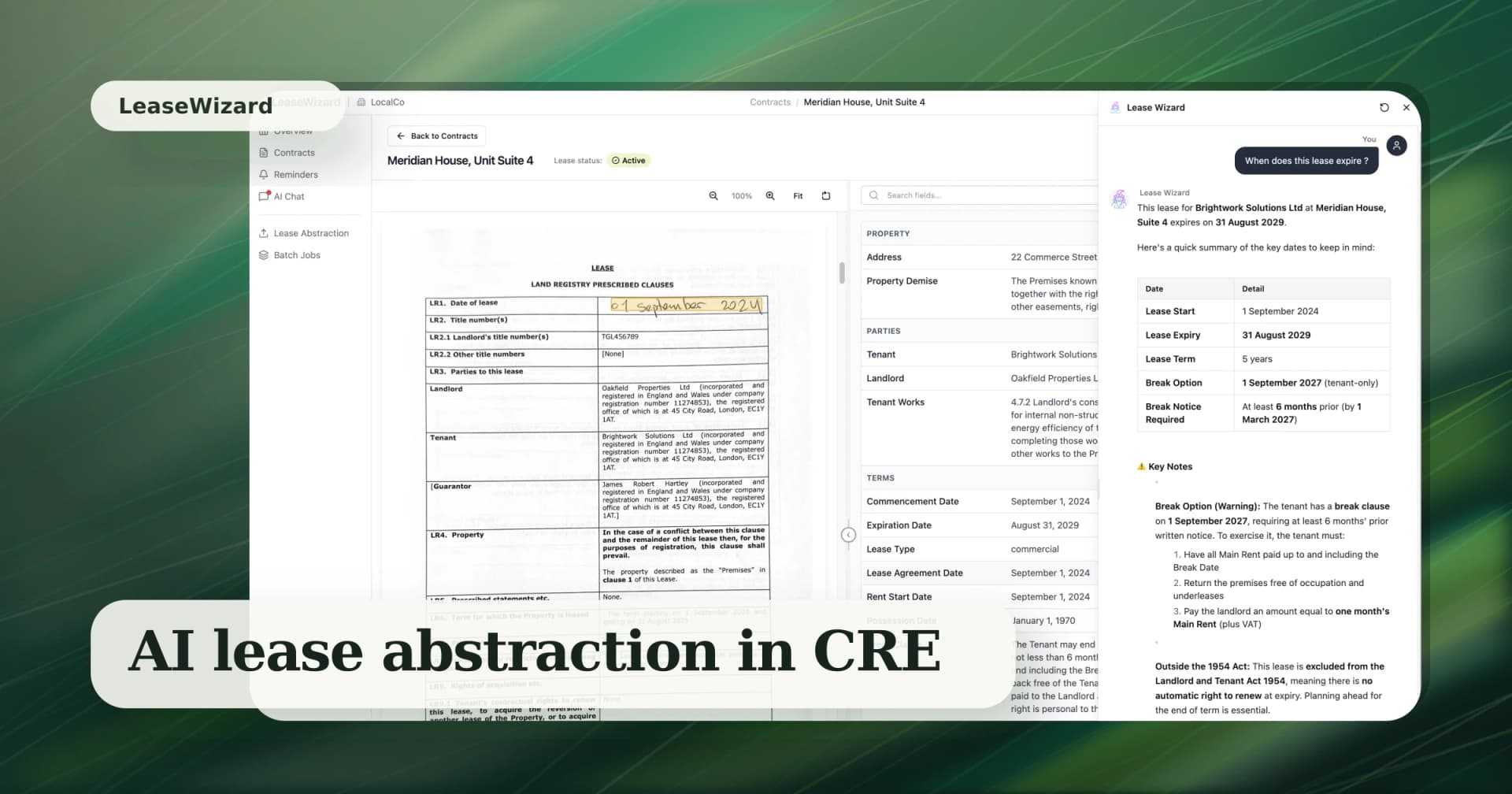
AI Lease Abstraction in CRE: What It Actually Fixes
Quick answer
AI lease abstraction in CRE turns lease documents into structured data teams can review, trust, and use for deadlines, rent schedules, options, obligations, and portfolio decisions.
AI Lease Abstraction in CRE: What It Actually Fixes
Answer: AI lease abstraction in CRE helps real estate teams turn leases, amendments, and related documents into structured data they can review and use.
That matters because commercial real estate does not break because nobody has the lease. It breaks because the important term is somewhere inside the lease and nobody sees it in time.
A renewal notice gets missed. A rent increase is not billed. A tenant has an option nobody modeled. A side letter changes the economics. An amendment overrides the clause everyone keeps quoting.
AI lease abstraction is useful when it makes those details visible before they become expensive.
What is AI lease abstraction in CRE?
AI lease abstraction in CRE is the process of using AI to read commercial lease documents and extract the terms that matter into a structured format.
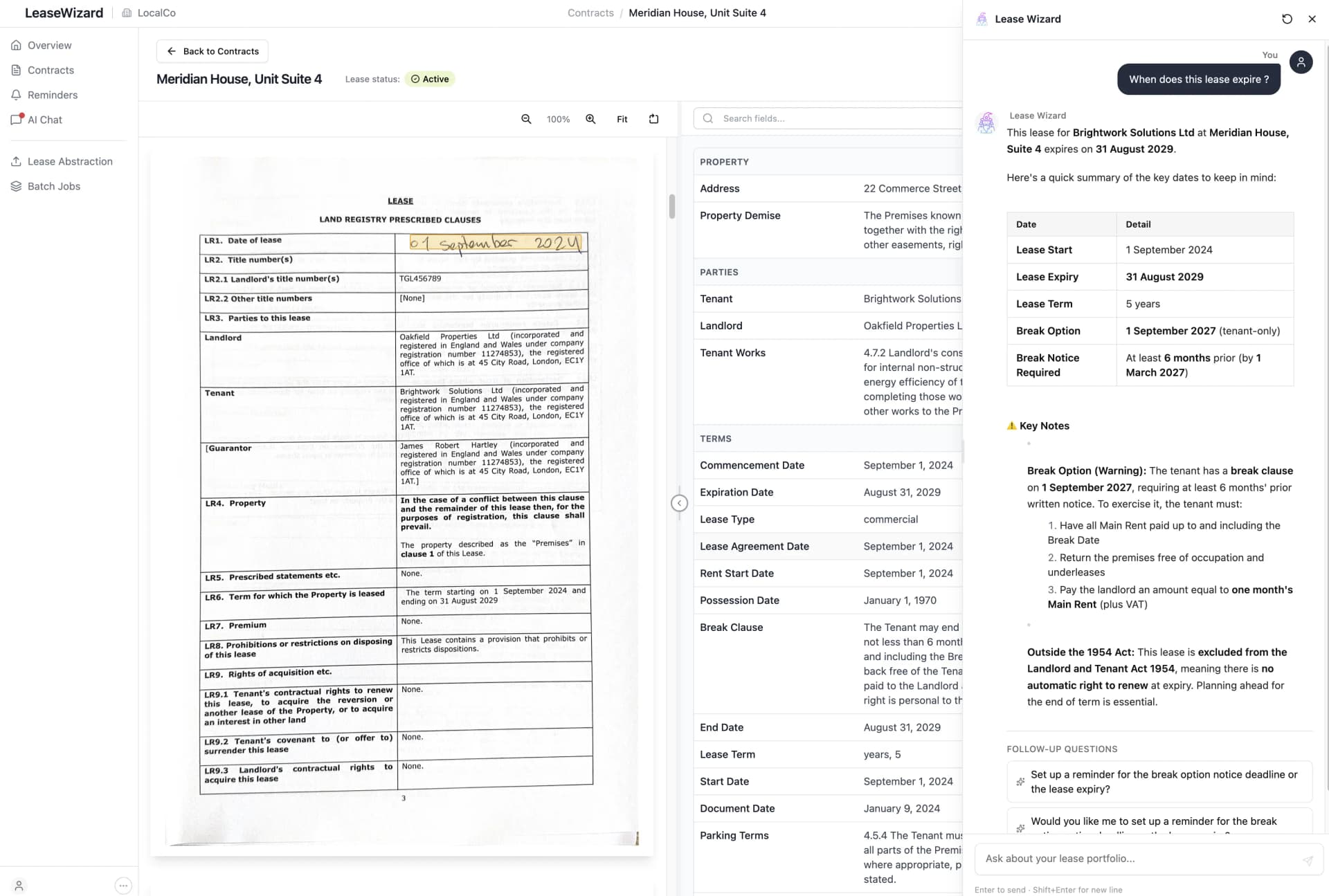
A useful abstract should capture fields like:
- Commencement and expiration dates
- Base rent and escalation schedules
- Renewal, termination, expansion, and contraction options
- Notice periods and critical dates
- Security deposits and guarantees
- CAM, tax, insurance, and operating expense language
- Assignment and subletting rights
- Use restrictions and exclusivity clauses
- Maintenance and repair obligations
- Tenant improvement allowances
The point is not to create a nicer summary. The point is to create lease data your team can work from.
Why CRE teams need more than lease summaries
A lease summary can be helpful. It is not enough.
Most CRE teams need answers that can drive actual work:
- Which leases renew in the next 12 months?
- Which tenants have notice windows coming up?
- Which rent escalations should already be active?
- Which leases include unusual termination rights?
- Which amendments changed the current rent or term?
- Which documents are missing from the file?
A generic AI summary may describe the lease. A real abstraction workflow turns the lease into fields, flags, dates, and exceptions.
That difference is important.
If the output cannot support reporting, reminders, diligence, accounting, or portfolio review, it is still just another document.
Where AI lease abstraction creates value
1. Faster due diligence
CRE diligence is document-heavy by nature. A portfolio may include base leases, amendments, addenda, notices, assignments, side letters, guarantees, and estoppels.
Manual abstraction slows the process down because someone has to read each file, find the relevant terms, and reconcile later changes.
AI can accelerate the first pass by extracting the core fields and showing where they came from. That gives legal, asset management, and finance teams more time for judgment calls instead of document hunting.
The best use case is not blind automation. It is faster review.
2. Cleaner lease administration
Lease administration depends on small details being right.
A missed date or wrong rent step can create revenue leakage, tenant disputes, audit problems, or last-minute fire drills. Across a portfolio, small errors become a real operating cost.
AI lease abstraction helps by standardizing the data every lease produces. When each lease is abstracted into the same structure, teams can track deadlines, compare terms, and keep records current with less manual cleanup.
Consistency is the value.
3. Better portfolio visibility
Leases contain the operating rules of the portfolio. The problem is that the rules are trapped in PDFs.
Once lease terms are extracted into structured data, teams can ask better questions:
- Where do we have early termination exposure?
- Which locations have below-market renewal options?
- Which tenants have exclusivity rights?
- Which leases include unusual repair obligations?
- Which documents need human review before a transaction?
That is where abstraction becomes portfolio intelligence.
4. Less repetitive work for skilled teams
Lease abstraction is important work, but much of it is repetitive.
Find the commencement date. Check the amendment. Confirm the notice period. Copy the rent table. Repeat.
AI can take over a large part of that first-pass reading. People still review the output, handle exceptions, and interpret ambiguous language.
That is the healthier division of labor: software handles volume; experts handle judgment.
How AI lease abstraction usually works
A strong workflow usually has six steps.
1. Upload the document set
The system ingests the base lease and related documents. This should include amendments, addenda, notices, exhibits, assignments, and side letters when they affect the current lease position.
Starting with only the base lease is a common source of bad data.
2. Convert documents into readable text
Scanned PDFs and images need OCR before the AI can read them properly. This step matters because lease files are often old, messy, or inconsistently formatted.
Poor text extraction leads to poor abstraction.
3. Identify the relevant terms
The AI finds clauses, dates, rent tables, obligations, options, and other lease terms. Good systems understand context instead of relying only on keywords.
That matters because leases rarely use identical language.
4. Structure the output
The extracted information is normalized into fields your team can use. Dates become dates. Rent schedules become tables. Options become trackable rights. Clauses become reviewable records.
This is where AI lease abstraction becomes operational instead of descriptive.
5. Flag uncertainty
Not every clause is straightforward. A good system should flag low-confidence fields, missing documents, conflicting terms, and provisions that need review.
Quiet uncertainty is dangerous. Visible uncertainty is manageable.
6. Human review
Commercial leases carry legal and financial consequences. Human review still matters.
The goal is to remove repetitive reading, not remove responsibility. The strongest workflows keep experts in control while reducing the time it takes to get to a useful answer.
What to look for in AI lease abstraction software
When evaluating AI lease abstraction software for CRE, avoid judging it only by demo speed. A fast answer is not useful if your team cannot trust it.
Look for:
- Structured fields, not only narrative summaries
- Amendment handling
- Source citations back to the lease text
- Review workflows for approvals and corrections
- Confidence indicators or exception flags
- Support for scanned documents
- Consistent outputs across the whole portfolio
- Exports or integrations for downstream systems
- Security controls for sensitive lease data
Source citations are especially important. If the system says a tenant has a renewal option, your team should be able to click directly to the clause that proves it.
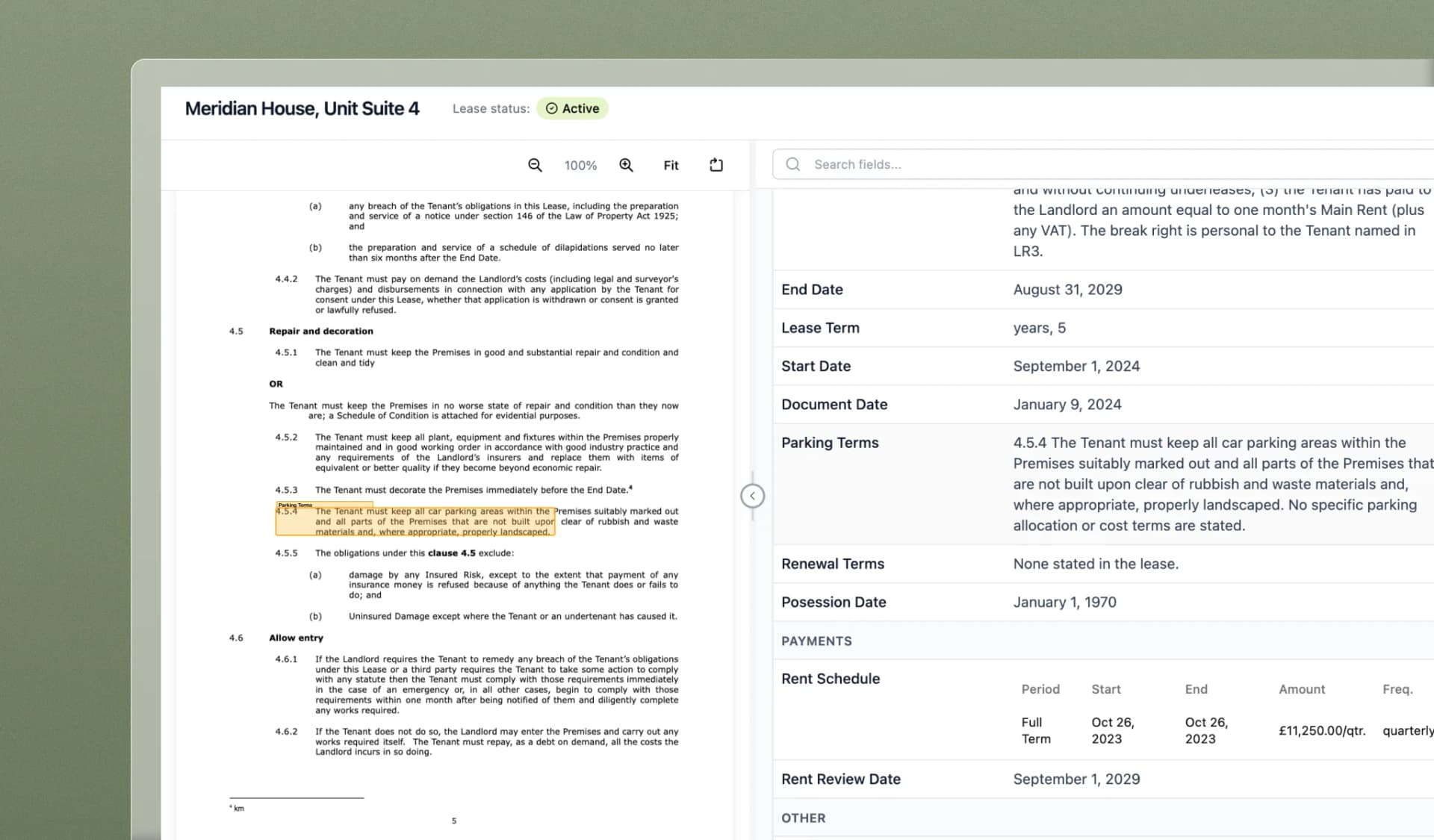
Trust needs a paper trail.
The common mistake: treating abstraction as a one-time project
Many teams abstract leases during a transaction, audit, or software migration. Then the data starts getting old.
That creates a familiar problem: the abstract says one thing, the latest amendment says another, and the spreadsheet is somewhere in between.
AI lease abstraction works best when it becomes part of the ongoing lease workflow.
New amendment signed? Extract it. Notice received? Connect it to the lease record. Option exercised? Update the current position.
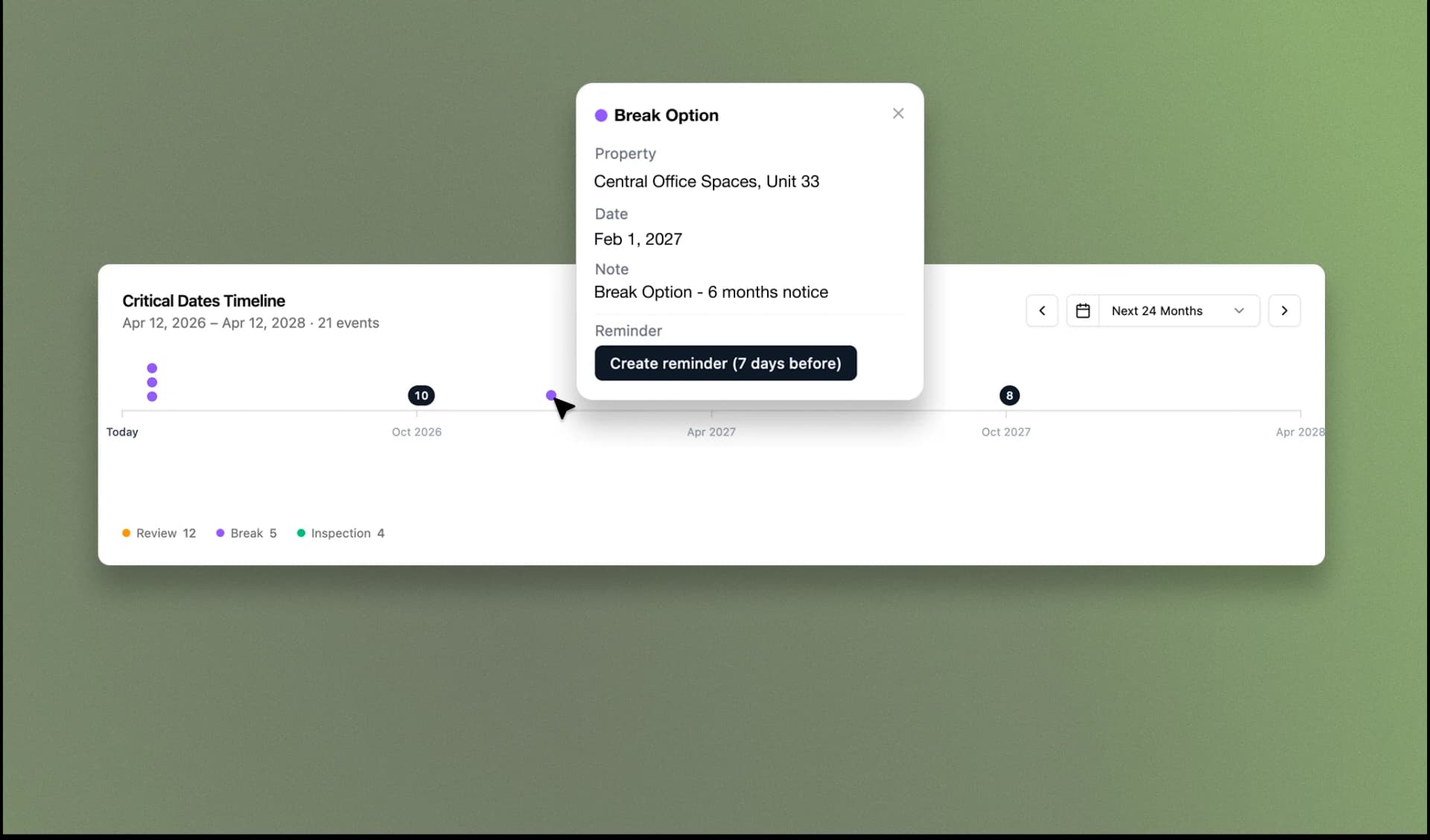
The goal is not a clean dataset once. The goal is lease data that stays clean.
How LeaseWizard fits this workflow
LeaseWizard is built for teams that need lease data to support real operating work.
That means:
- Extracting lease terms into a fixed structure
- Keeping amendments connected to the lease timeline
- Surfacing exceptions for review
- Helping teams track dates, obligations, and portfolio risk
- Turning lease files into data that can support decisions
For CRE teams, the win is not that AI reads faster than a person. The win is that the portfolio becomes easier to understand, review, and manage.
Final Thought
AI lease abstraction in CRE is not about replacing expertise. It is about giving experts better starting points.
The lease is still the source of truth. AI makes that truth easier to find, structure, and act on.
If your team still depends on manual abstracts, scattered PDFs, and spreadsheet updates, that is the workflow to fix first.